
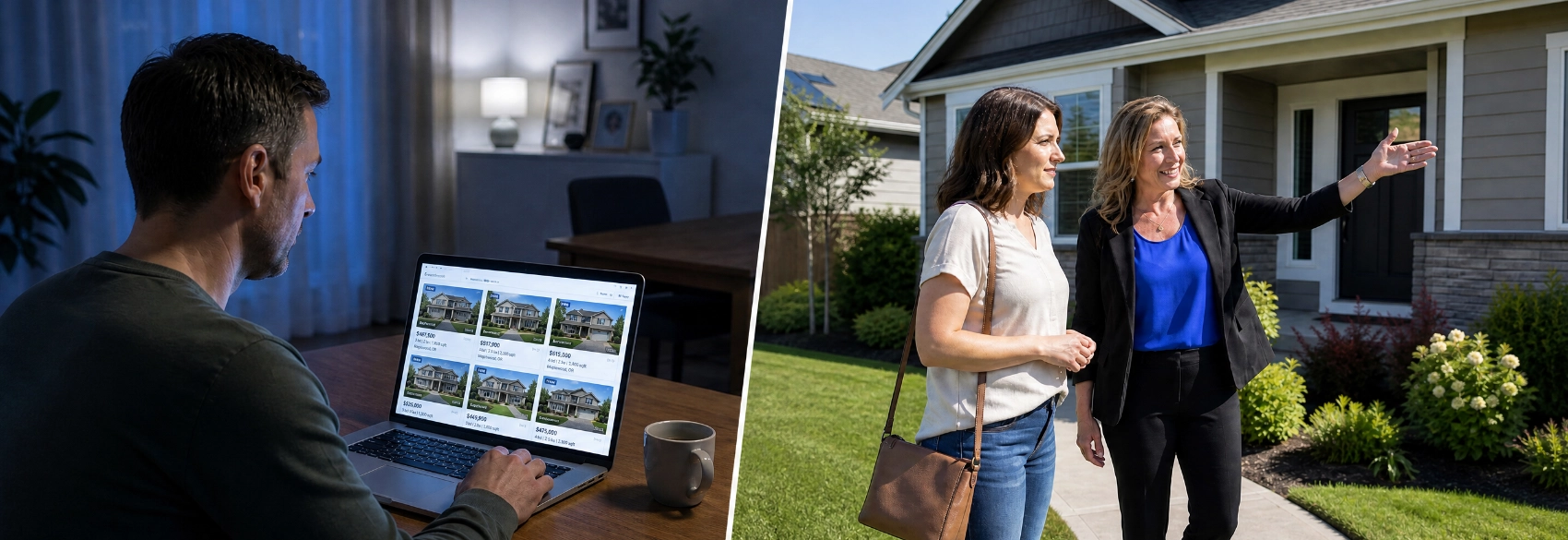
Every week I talk to buyers who did the same thing: they started searching on their own. Zillow.com, Realtor.com, Redfin, they spent hours scrolling, saving favorites, going to open houses. That's useful when you're in the "not ready to buy" phase and educating yourself on the market. But if you're close to ready, you may run into the problem that by the time they call me, most of those homes are gone.
DO NOT CALL THE LISTING AGENT!!
4 Real Life Stories That Illustrate The Pitfalls Of Searching Alone!
Story 1: The Open House Confession
Mark and Lisa found a house they loved in Voorhees. Four bedrooms, updated kitchen, corner lot. They went to the open house on Sunday, introduced themselves to the agent at the door, and started chatting. The agent was warm and friendly. By the time they left, they had told her their budget ($420K), that they were already under contract on their current house and needed to close in 60 days, and that this was the best house they'd seen in three months.
The Seller's Listing Agent Works for the Seller
That friendly agent at the door? She was the listing agent. Her job is to get the best deal for the seller. Everything Mark and Lisa told her, their urgency, their ceiling, their desperation, she was now legally required to share with her client.
The sellers listed at $399K. They came back with a counteroffer at $415K. Mark and Lisa paid $12,000 more than they needed to because they unknowingly handed the other side a negotiating roadmap.
The tip: At any open house, assume everyone there works for the seller until proven otherwise. Don't share your timeline, your budget, or how much you love the house. That's your agent's job. They know how to have these conversations strategically.
Story 2: The Zestimate Was $40K Off
Dana found a house in Cherry Hill listed at $378,000. Zillow's Zestimate showed $418,000. She was convinced she was getting a deal. She went in at list price without asking any questions, thrilled she was saving $40K against what the algorithm told her the house was "worth."
Here's What She Didn't Know
The house had been listed twice in the past 8 months. The first deal fell through during inspection when the HVAC was found to be original to the 1987 build. The second buyer backed out after the appraisal came in at $361,000.
The actual comps? Three similar homes within a half mile had sold between $355K and $370K in the past 90 days. The Zestimate was inflated by one outlier sale in a larger house two streets over.
Dana paid $378K. A proper CMA (Comparative Market Analysis), which her agent would have run before she ever set foot in the house, would have shown the real number was closer to $362K. She overpaid by roughly $16,000 before the negotiation even started.
The tip: Zestimates are based on public data and algorithms. They don't know about the failed inspection, the two cancelled contracts, the drainage issue in the crawl space, or the actual sold prices your agent can pull from MLS. Never use an online estimate as your price anchor.
Story 3: The House That Was Gone Before It Was Listed
Tom and Alicia had been watching Zillow like it was a stock ticker. They had alerts set up, saved searches, the whole system. They knew that houses in Moorestown in their price range moved fast, so they were ready to jump.
In March, the house they'd been waiting for, four beds, finished basement, walkable to the town center, went live at 9 AM on a Tuesday. Tom saw the Zillow alert at 11 AM. They called to schedule a showing. It was already under contract.
What Actually Happened
The listing agent had the property as "Coming Soon" in MLS for six days before it went active. During that window, she called every buyer's agent in her network with active buyers in that price range. By the time the house hit Zillow, which syncs from MLS with a delay, four buyers had already toured it. Two offers were submitted the night it went "active" at midnight.
Tom and Alicia didn't see the Coming Soon listing because they weren't connected to an agent with MLS access. Zillow doesn't show Coming Soon properties consistently, and when they do appear, the sync lag can run 24 to 48 hours.
The tip: The public portals are downstream. MLS is upstream. Your agent sees new listings, Coming Soon status changes, and price drops in real time, and they have relationships with other agents who will call them first when something matches your criteria.
Story 4: The Algorithm Doesn't Know Your Commute
Kevin searched "homes under $380K in Cherry Hill" and fell hard for a house on the eastern side of town: beautiful yard, updated kitchen, priced right. He made an offer, it was accepted, he closed. He was thrilled.
Three months later he called me. His commute to his office in Conshohocken had gone from 35 minutes to 55 minutes every single day because of how that neighborhood sits relative to 295 and Route 38. He hadn't tested the drive before making an offer. He asked me if he could sell and break even. He couldn't.
What an Agent Would Have Done
The first thing I ask every buyer before we tour a single house: where do you go every day, and at what time? We then test-drive those routes during rush hour before they fall in love with anything. Cherry Hill alone has enormous variation in commute times depending on which neighborhood. A house near Kings Highway versus a house near Haddonfield Road can be a 20-minute difference heading north in the morning.
No search filter catches that. No algorithm maps it. It takes someone who has driven those roads for years and asks the right questions upfront.
The tip: Searching by zip code tells you almost nothing about what daily life actually looks like. An agent who knows your target area gives you the context a map can't.
Bottom Line - Don't Search Alone
I love that buyers come in informed. Look at Zillow. Set your Redfin alerts. Drive neighborhoods on weekends. That's all great context. But there's a difference between doing your homework and going into a competitive market without representation, without MLS access, and without someone whose full-time job is to protect your interests.
Every one of the four stories above happened because the buyer was operating with incomplete information in a system that isn't designed to be neutral. The portals are built for engagement. The listing agent works for the seller. The algorithm doesn't know your life. That's why I say it every time: don't search alone. Your agent is your best resource.