
How to Price Your Home
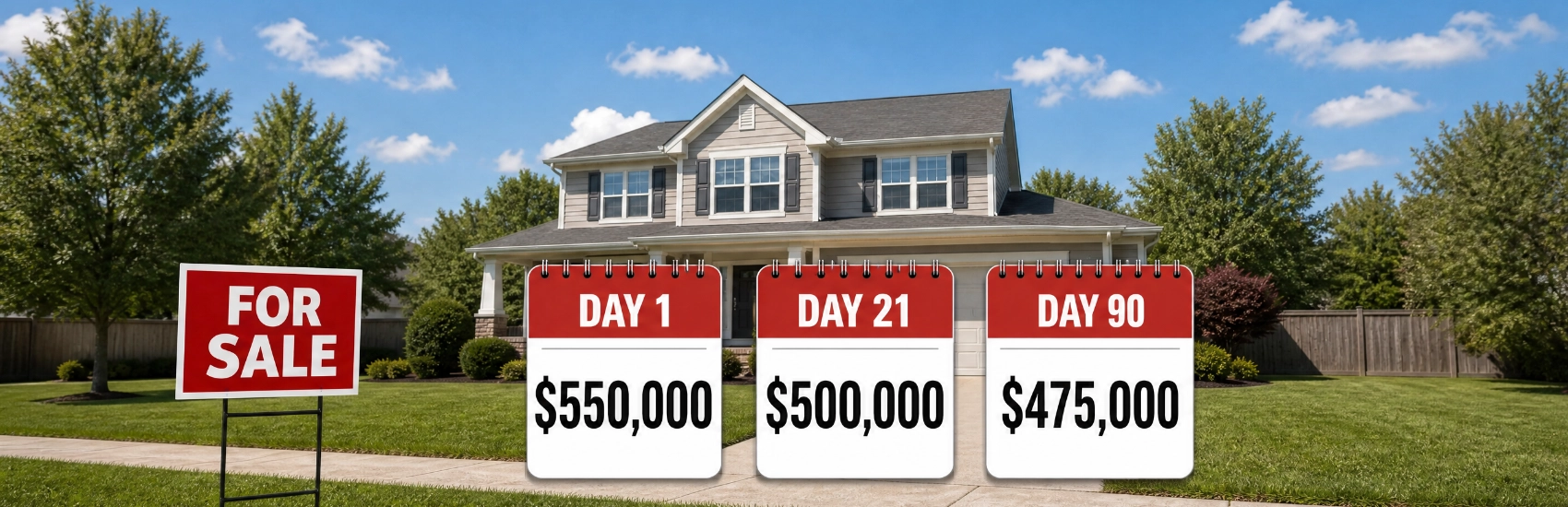
Every seller thinks they know their home's worth. They know what they paid, what they've put in, and the care they've given it. They know the neighborhood's value, the schools. That knowledge feels like a foundation for pricing.
But it isn't. Not entirely. What your home is worth is driven by what it means to you, and "what's my home worth" is the exact question every real estate lead-generation tool is built around. It's the wrong question. The one that matters is what it will actually sell for. Price is what a buyer will pay on a specific day in a specific market against specific competition. The gap between those two numbers is where most discussions of pricing run into trouble.
This is where Smart Pricing comes in: not a formula, but a deliberate look at the seller, the buyer, the market, and the agent, the four variables that actually determine what a home sells for.
The Four Variables of Smart Pricing
What's the perfect price? What's the sweet spot? Where is the magic? There is no set formula for pricing a home for sale. But there are key factors that will impact how successful your home sale is. Some agents will simply tell you what you want to hear to get the listing, and others simply check how resistant you will be to price reductions in the future. Is your listing agent comfortable discussing all four primary variables? Most listing presentations only talk about one or two of them, and that's usually where the pricing gap starts.
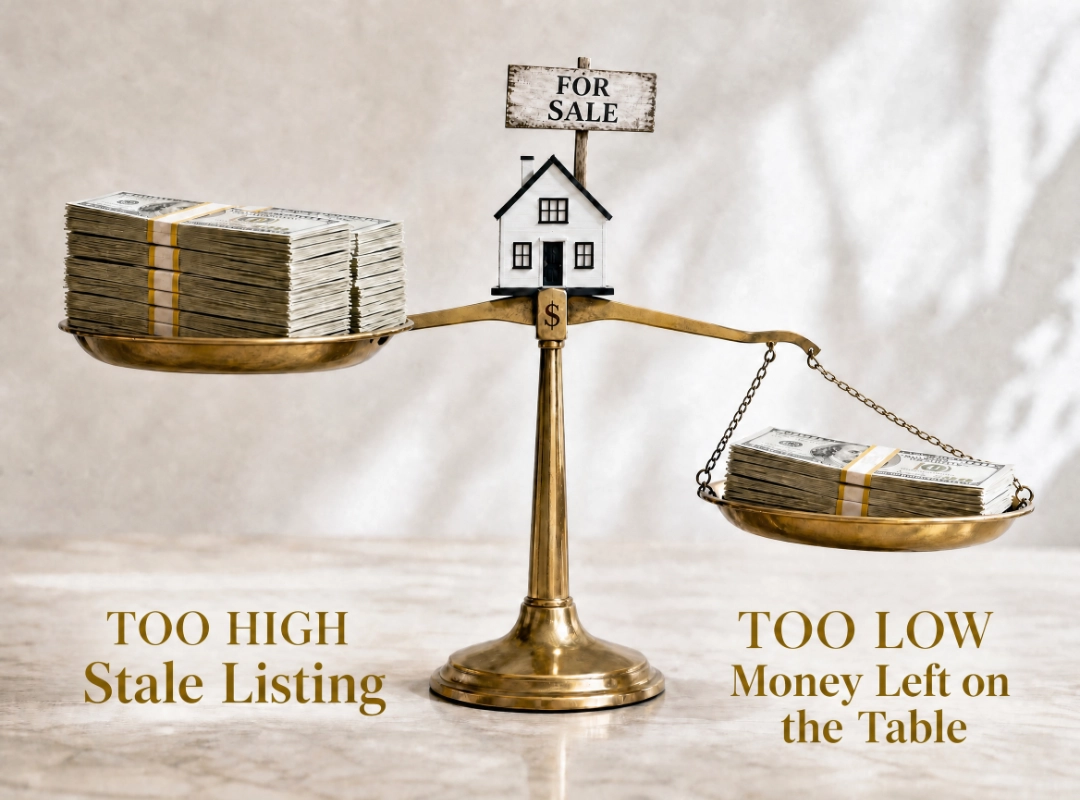
This is the most emotionally loaded variable, and the one most likely to push a price in the wrong direction.
Variable 1: The Seller
Sellers price from the inside out. You start with what you know: what you paid, what you spent on renovations, what your neighbor's house sold for two years ago, what you need to net to make your next move work. All of that is real information. But none of it is what buyers use to decide if they'll pay the price.
Research from Wharton backs this up. The fear of leaving money on the table pulls about 2.5 times harder than the appeal of a fast, clean sale. That's strong enough to make sellers override their own CMA and price higher than the data supports.
That same study found that listing just 20% above market value cuts the odds of a fast sale by 20 to 30%. The Cherry Hill numbers later in this post show exactly that pattern playing out. It is completely human, and it can cost you.
The worth-versus-listing-price gap starts because buyers price from the outside in.
Variable 2: The Buyer's POV
They don't see your costs, equity, or home improvement receipts. They see comparable home prices.
When a buyer looks at your home, they are simultaneously comparing it to every other home in their search range. They apply the principle of substitution. They will not pay more for your home than it would cost to acquire something comparable elsewhere. They don't care what your kitchen renovation cost. They care whether the kitchen is better than the other kitchens they've seen this weekend. This is the worth-versus-listing-price gap, made concrete. What you know about your home and what a buyer will actually pay for it are two different calculations.

The "Market" is the true determinant of price.
Variable 3: The Market
Step 1: the CMA (Comparative Market Analysis) is where the hard data starts: what's sold in the past six months, what's actively competing nearby, and what a buyer in your range might also be considering farther out from your location. The thoroughness and accuracy of your agent's CMA presentation is critical.
Step 2: Once your listing goes live, the market talks back, telling you in the first two weeks how your listing, price, photos, and description are being received. No showings in that window, or three or four showings each week with no offers, are important signals.
An agent's ability to process the data and read the signals is based on their years of experience. More importantly, so is their ability to react in a timely manner. They understand their job is to keep you front and center in the listing game.
"The Market is the true determinant of price" sounds very authoritative, but the seller or their agent ignores it at their peril.

Your agent is the variable that makes or breaks the other three.
Variable 4: The Agent
The best agents aren't just listing agents. They've spent real time on the buyer side too, and know firsthand what makes a buyer say yes or walk away. That buyer point of view matters twice: once when you're setting the price, and again later when you're negotiating an offer. It's one more reason the agent is such a critical part of the process.
The agent's job is to hold all four variables in balance simultaneously, and to translate them into a pricing decision you can defend at any point in the process. Not just at the listing appointment, but when a buyer comes in with a Zestimate, when the first showing feedback arrives, when you're deciding whether to wait one more week or adjust.
That's not a formula. It's judgment built from experience.
Why Online Home Value Tools Don't Actually Tell You What Your Home Is Worth
Zillow's Zestimate can be off by $35,000 or more on a typical home, and the "free home value" forms online exist mainly to collect your contact information, not to price your home.
Zillow's Zestimate is the most familiar version of what's called an AVM, short for Automated Valuation Model. Redfin, Realtor.com, and most bank websites run their own version of the same idea: an algorithm crunches public records and recent sales, then spits out a number.
Zillow publishes its own accuracy numbers, and they're wider than most people expect. For homes currently listed, the median error is under 2%. For homes that aren't on the market (which is most people just checking out of curiosity), the median error jumps to around 7%. On a $500,000 home, that's a swing of roughly $35,000, and that's the median: half of all estimates are off by more than that.
The gap exists because an algorithm has never walked through your house. It doesn't know your kitchen was redone last year, or that your street backs up to a park instead of a busy road. It only knows what's in public records.
Here's the part most sellers don't realize. Those "what's my home worth" forms aren't really there for you. They're a lead-generation tool. The estimate is the bait; your name, email, and phone number are what the site is actually after. Some of those leads get sold to three or four different agents at once, which is exactly why filling out one of these forms can lead to calls from agents you've never heard of, each quoting a slightly different number.
And here's the insider part. A lot of agents are trained to use that very discrepancy as their opening line. "These automated tools can be a bit off sometimes. Did you do any renovations the algorithm wouldn't know about?" isn't really a question about your home. It's a script, designed to get you talking.
None of this makes the number useless. It's a fine starting point for idle curiosity. It just isn't a pricing strategy. That's what a CMA is for, an agent who's actually seen your kitchen, knows what closed two streets over last month, and can tell you why the algorithm's number is or isn't in the right neighborhood.
Pricing Strategies
There's no single right answer here, and the research backs that up. Even the academic studies disagree with each other. Pricing just under a round number is often called charm pricing, and some studies find it nets a higher final sale price. Others found the opposite, because charm-priced listings get buried at the bottom of a low-to-high search sort, where buyers spend far less attention than on the first few homes they see. The honest answer is that it depends on your specific home and market, not a formula that works the same way every time.
Price exactly at a round threshold, like $500,000 instead of $499,900, and your listing shows up in two search brackets instead of one: everything up to $500,000, and everything starting at $500,000. If you want maximum exposure, or your home is genuinely competitive at the top of its range, that double visibility can matter more than anything psychology is doing.
Price just under that same threshold and you're using charm pricing, betting on perception instead. Buyers process $499,900 as meaningfully cheaper than $500,000, even though it isn't. If you go this route, the research is specific about which ending actually works. Prices ending in 900 or 000 outperform prices ending in 999 or 990, so $499,900 is the stronger choice, not $499,999. That bet tends to pay off when you need every edge to get showings started, in a slower market, or a price point with heavy competition.
Two different things are happening inside charm pricing. The bracket effect is purely mechanical. Either your price falls inside a buyer's search filter or it doesn't. The left-digit effect is psychological. Buyers really do process $499,900 as meaningfully less than $500,000, even knowing better. The research can't fully separate how much of any price premium comes from one versus the other, so treat the bracket math as the solid, dependable part of this, and the psychology as real but harder to bank on.
Above a certain price point, the calculus flips. Luxury buyers read charm pricing as a red flag, a sign the seller is anxious to move, or that the home is compensating for something. A $1,250,000 listing signals confidence. $1,249,000 can signal the opposite.
Which approach fits a specific home comes down to where the competition is clustered, how the local market is moving, and where the home sits within its own price range, not a rule that applies the same way twice. Here's what actually happened when charm pricing met real buyers in Cherry Hill.
Real Life Pricing: Cherry Hill and Philadelphia
Everything above is strategy. Here's what actually happened. 151 four-bedroom homes sold in Cherry Hill, and 288 homes sold in Philadelphia (mostly two- and three-bedroom), both between January 12 and July 11, 2026. Real MLS data, list price, sold price, and days on market for each.
Timing still wins, but not equally everywhere
The chart below shows the relationship between days on market and your closing price relative to your listing price, in Cherry Hill and Philadelphia. Watch what happens to the gap between listing price and closing price as the number of days on market increases.
In Cherry Hill, homes that sold in the first two weeks closed at a median of 104.8% of list price, a real bidding-war premium. In Philadelphia, even the fastest sales only reached 100% of list, no premium, just less of a discount than the slower sales saw. Same principle in both markets: homes the market recognizes as well-priced sell faster. And the longer your home sits on the market, the more it risks a substantial gap between list and closing price, likely because buyers factor time on market into their offer.
"If it's been sitting this long, something must be wrong with it," is exactly what a buyer thinks when they see a stale listing, whether or not it's true.
0–14 days
15–30 days
31–60 days
61–90 days
90+ days
Median sold-to-list price ratio by days on market, January 12–July 11, 2026. Cherry Hill: 4-bedroom sales. Philadelphia: primarily 2–3 bedroom sales; 18 Philadelphia sales with 150+ days on market were excluded as atypical outliers before this analysis.
Every home is its own situation. Condition, location, and timing can pull a specific sale away from the median in either direction. What the data shows is the pattern: as days on market climb, the median sold-to-list ratio steps down in both markets, and in Cherry Hill it eventually drops below 100% once a home crosses two months on market.
Charm pricing almost never survives to closing
Of the homes listed with a "charm" price like $499,900, 91% closed at a round number instead. Only one home in the entire 151-sale dataset actually closed on a charm price.
At listing, 23% of homes used charm pricing and 68% used a plain round number. By closing, that gap nearly disappears. 90% of final sale prices are round, and charm pricing shows up in less than 1% of actual closings.
| Price pattern | At listing | At closing |
|---|---|---|
| Charm ($X99,900 / $X99,999) | 23.2% | 0.7% |
| Round thousand ($X00,000) | 67.5% | 90.1% |
| Round-under-threshold ($399,000, $699,000) | 5.3% | 0.7% |
| Half-round ($X,X50,000) | 3.3% | 3.3% |
Negotiation naturally rounds numbers off. Counteroffers, seller credits, back-and-forth all pull a price toward something clean. Whatever a charm price does to catch a buyer's eye while they're scrolling search results, it rarely survives the conversation that follows. The tactic works at the listing stage. It isn't what determines the final number.
What a Pricing Conversation Should Actually Cover
When you sit down with a listing agent, the pricing conversation should cover all of this, not just comps:
-
Your Financial Reality
What do you need to net? What are your carrying costs if the home sits? What is your true timeline? These seller variables shape every other decision.
-
Comparable Sales and Active Competition
Not just in your neighborhood, but the full radius a buyer in your price range is searching.
-
Bracket Positioning
Where does your price land relative to the search filters buyers are using? Are you at a threshold that works for you or against you?
-
Buyer POV for Your Price Point
What do buyers at this price expect to see? What does your home deliver that they won't find elsewhere? Where are the gaps?
-
A Plan for the First Two Weeks
The first fourteen days on market are peak activity, when the most motivated buyers are watching. Sellers who accept an offer in week one have roughly a 57% chance of closing at full list price; that drops to about 32% by week five. A pricing strategy that accounts for that window is fundamentally different from one that just picks a number and hopes.
If you didn't hear most of that in your last listing presentation, you didn't get the full conversation.
True Stories
I was selling a home in the Springbrook neighborhood in Cherry Hill, and an agent doing a listing presentation showed me homes that had recently sold in Barclay Farms, a very different home type and demographic. When I asked why he only included Barclay Farms, he was flummoxed and said they were in the same price range, which was a clear indication he didn't understand how to do a CMA.
A family bought a home in a desirable neighborhood about five years ago for $750,000. They made no improvements over the years. The house stayed in good condition, but with the original builder amenities. Between all the real estate news pushing bidding wars and "sell now" urgency, they listed at $1,050,000.
Nothing in that neighborhood had ever sold anywhere near $1 million. Other homes actively on the market nearby were selling in a much more modest range, with the highest at $875,000. The sellers ignored that entirely.
Over the next six months, two different agents took the listing at that same price. Both times, the contract was withdrawn. There were few, if any, showings. A glance at the listing photos alone was enough to see the price didn't match the house. Whether either agent pushed back or simply went along with it, testing the market that aggressively isn't ambition. It's a no-no, and it hurts everyone, not just the seller who sits unsold.
We listed a condo at $399,900, priced tightly against the comps and expected a bidding war. Two days later, an identical unit went live in the same community: same year built, same layout, same everything, except a full tiled bath in the basement.
That one feature was enough. Buyers who would have toured our listing went to see the other unit instead. It sold within two weeks inside the same window that should have been our best shot at multiple offers.
Our pricing strategy was on target but market forces intervened. We were no longer the fresh listing, and the moment for a bidding war had passed. Time on market, not price, became the problem. By the time the competing unit closed, the damage to our momentum was already done.
The Number That Matters Most
Sellers often fixate on list price. The number that actually matters is net proceeds, what you walk away with after commission, closing costs, carrying costs, and any price adjustments along the way.
The instinct to price optimistically comes from the same place as the fear of leaving money on the table, but it can work against the very thing it's protecting. A home priced right that sells quickly usually keeps its negotiating room intact. A home priced too high, then reduced once or twice before it finally sells weeks later, often ends up with lower net proceeds than if it had been priced accurately from day one, even though its original list price looked higher on paper.
Your agent should help you fixate on your net proceeds. This is the pricing conversation worth having.
Bottom Line - Pricing Your Home
Smart Pricing: don't get fancy, don't move too fast, rely on data, not a hunch.
Charm pricing, bracket positioning, round-threshold visibility. All of it is real, and all of it matters at the moment a buyer is scrolling. But 91% of the charm-priced homes that sold in Cherry Hill closed at a round number anyway. The trick gets attention. It doesn't close the deal.
What actually determines where a home lands is the same thing it's always been. A seller's acceptance and accurate analysis of the market, real comps, and an agent who knows which strategy fits which house.
Statistics and research cited above, including the Wharton loss-aversion study and market timing data, reflect research current as of May 15, 2026. Market conditions and published research can change over time.